
Customer Knows Best- The Impact of Customer Reviews and Importance of Online Reputation Management

Customer reviews are an important part of buying and selling products and services, whether a company sells online or in-store. With the introduction of social media, websites like Yelp and TripAdvisor, and the increasing trust in customer reviews on the internet, it is becoming more and more important for a business to monitor and encourage online customer reviews.

Before getting into the impact of customer reviews, something that needs to be covered is deciphering whether or not a review is real or fake. This is a huge thing to pay attention to for online shoppers or review readers, as sometimes untrustworthy companies will pay people to write fake reviews for them to get their ratings up or generate more traffic. This is an illegal and morally wrong practice, and it is sometimes hard to spot fake reviews even with a trained eye.

MarketWatch published a list of 10 things that will help customers keep an eye out for the fake reviews that are sometimes utilized, and the first thing that they mention is looking for an overuse of the pronouns “I” and “me.” The website states that, “According to research from Cornell University, online reviews that frequently use “I” and “me” are more likely to be fake than those that don’t — possibly because when people are lying they try to make themselves sound credible by using personal pronouns.” (MarketWatch, 2018). Other things to watch for in a review that may point to it being fake are generic names, such as John or Jane Smith, poor English or grammar, or if the reviewer has given multiple 5-star reviews to the same company.

Real and fake reviews both have an impact on e-retailers, and people will often visit the reviews to make the decision on whether or not to purchase a product or service. That makes ORM (Online Reputation Management) a very important thing for businesses, especially online retailers, to pay attention to. According to an article on G2 Learning Hub written by Kristin McCabe, “Having five reviews results in purchase likelihood increasing by a factor of almost four times (Spiegel Research Center, 2017)” (McCabe, 2019). This helps prove that reviews have an impact on customer’s decision making, even when just looking at the number of reviews.

Managing a business’ online reputation is an underrated art for some smaller businesses who may not understand or pay attention to the realm of review websites and social media comments. Personally, I worked for a business that was not aware that their business was on a review website for many years, and they never responded or managed the few bad experiences that people commented about. Although there were only a small number of these experiences, as there will be at any business, it could have put a few customers off from visiting. I eventually did enough encouraging to get them to claim the business on the review sites and start working towards better ORM.

ORM is a very important part of business that can be overlooked due to the novelty of it, and I would like to see more businesses getting serious about it. Reviews can have a huge impact on the volume of customers that are purchasing items, and can alert you of common problems that customers may be having. Whether looking to improve your business, or wanting to increase a customer base, ORM is the best way to work towards those goals.

Resources

Hill, C. (2018, December 10). 10 secrets to uncovering which online reviews are fake. Retrieved from https://www.marketwatch.com/story/10-secrets-to-uncovering-which-online-reviews-are-fake-2018-09-21

McCabe, K. (2019, September 20). 50 Statistics Proving the Power of Customer Reviews. Retrieved from https://learn.g2.com/customer-reviews-statisticsSteele, B. (2011, July 25).

Some online reviews are too good to be true; Cornell computers spot ‘opinion spam’. Retrieved from http://news.cornell.edu/stories/2011/07/cornell-computers-spot-opinion-spam-online-reviews
The Difference Between Men and Women’s Habits in E-Retail

There are many differences in how men and women shop, especially in the e-retail world. There is a lot of commentary in the news and online about gender roles and how tradition is being broken regarding stereotypes and typical behaviors of each gender. However, numbers and statistics don’t lie, and the trends show that there are still differences in the online and traditional retail shopping behaviors of men and women.

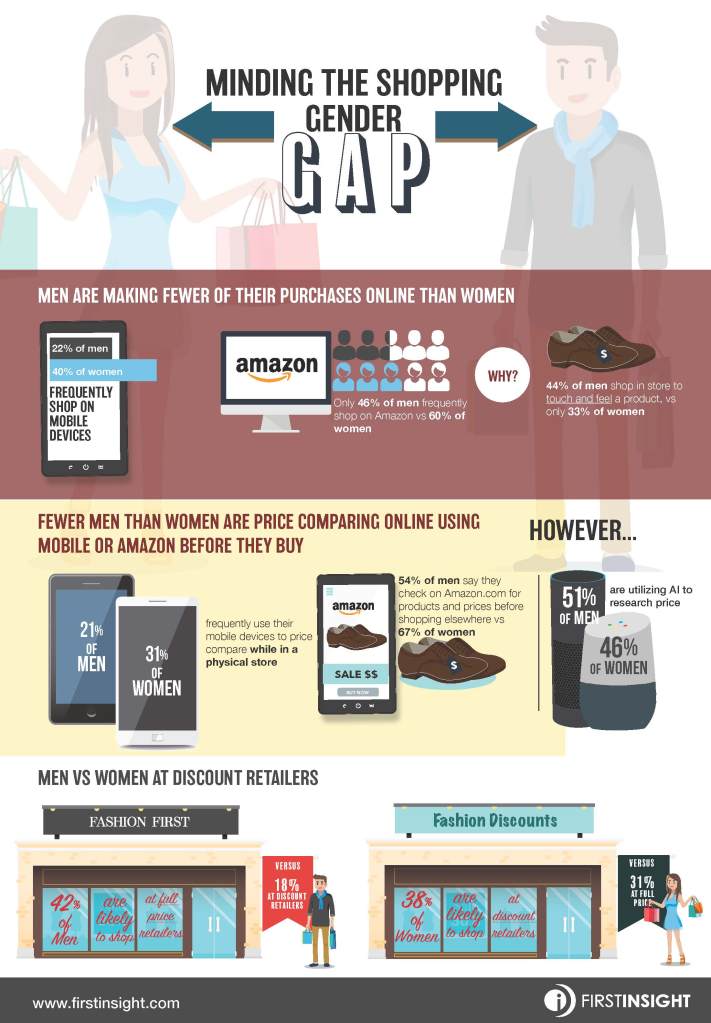
In an article on CNBC’s website, Lauren Thomas points out that, “Women like e-commerce for shopping, while men still prefer bricks and mortar, according to a new survey from First Insight.” (Thomas, 2018). This is an interesting statistic to look at. One possible reason that women like to shop online more than men do is because they are still usually responsible for the main caregiving of kids and older people. This means that they will likely be buying more things for more people and providing for others. Naturally, the primary caregiver of the family is usually more inclined to find the best price or the best product for them, and online retailers are an easy way to compare prices, features, and products in general.

There is an interesting infographic that was also posted along with the article mentioned above, and it goes through a couple of statistics that are pertinent to the topic of the differences between men and women shopping online. These statistics help put the differences into perspective in a more visual way rather than just straight numbers, which I find is helpful in a case like this.

Multiple articles online and people that I’ve asked mentioned that men typically like to touch and feel the products first in-store rather than purchasing products online. Women are more inclined to just purchase the product without having to feel the texture or fabric, which in turn creates more incentive to online shop. Since men typically enjoy physically going to stores and touching a product before they buy it, that does not encourage online shopping as much as women’s tendencies do.

Another difference in men’s and women’s online shopping habits is the viewpoints of the different genders. Bogdan Rancea wrote an article on ecommerce-platforms.com that states, “Based on a survey conducted by the Key Note Media Centre, males tend to view shopping as a chore… Women, on the other hand, treat shopping as a fun event.” (Rancea, 2019). In society, shopping has been viewed as a women’s thing to do, and when you go to a place like the mall you often see men sitting or standing outside of stores waiting for their female counterparts. The same can be seen in online shopping. Women tend to windowshop and browse more than men do, since men typically look at shopping has a necessity rather than as a fun thing to do.

The book Internet Retailing and Future Perspectives details an additional difference between male and female shoppers, saying, “Differences between male and female shopping styles may go back a long way. In hunter-gatherer societies, females tend to carry babies, are based around the camp and do the gathering. Males on the other hand are more likely to protect the group and do the hunting. Humans may have evolved in such a way that those best at their respective roles have been more likely to find a mate and to survive.” (Pantano, 2017). This is interesting because this suggests that the differences that we see in how men and women shop online may be due to a primal instinct from early human societies. This is the most interesting and, in my opinion, the most scientific basis for the reasoning behind the difference in male and female shoppers.

Shopping online has become so easy that virtually anyone can figure it out. Even children are buying products online through AI technology and virtual assistants. This means that more and more people are buying products online, which gives us many more subjects to study to see the differences between male and female shoppers in the online realm. I’m excited to see what else is uncovered!

Resources:

Laurenthomas. (2018, March 19). Men aren’t willing to shop online as much as women, survey finds. Retrieved from https://www.cnbc.com/2018/03/19/men-arent-willing-to-shop-online-as-much-as-women-survey-finds.html

Pantano, E., Bang, N., Dennis, C., Merrilees, B., & Gerlach, S. (2017). Internet retailing and future perspectives. Abingdon, Oxon: Routledge.

Rancea, B., & Rancea, B. (2019, February 20). Male Shopping Habits Versus Female Shopping Habits. Retrieved from https://ecommerce-platforms.com/articles/male-shopping-habits-versus-female-shopping-habits

Design a site like this with WordPress.com
Get started